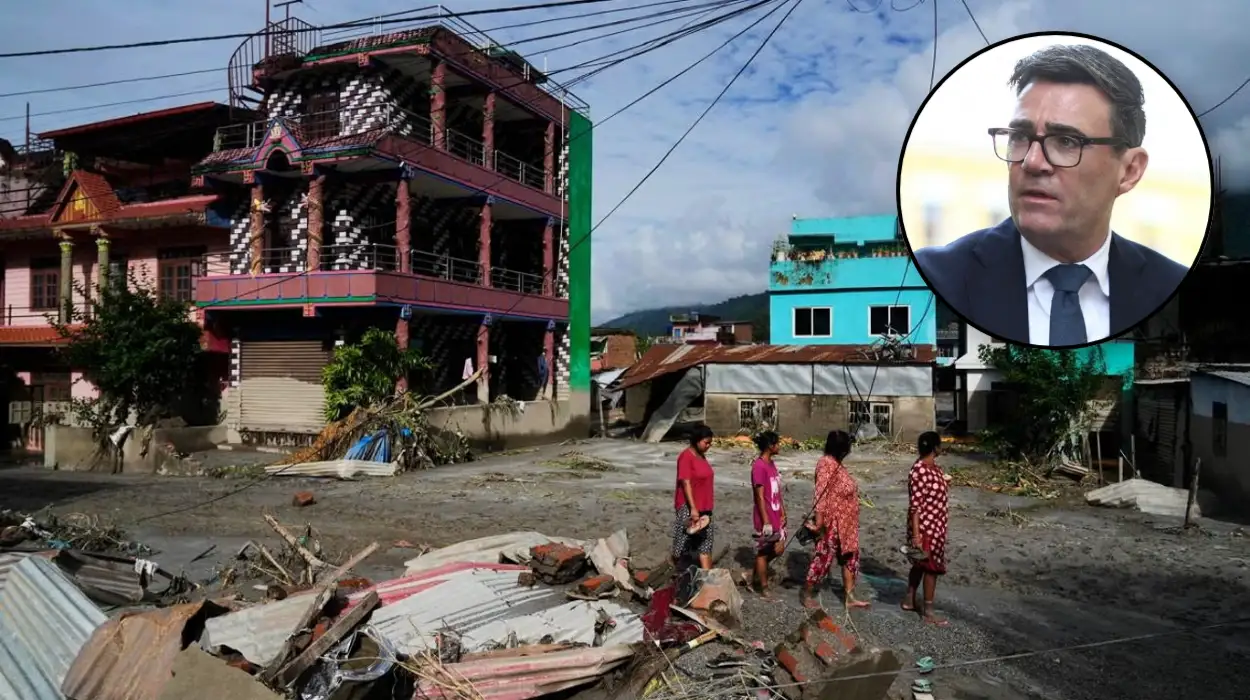
Key Points
- The UK has offered Nepal £5 million (around US$6.8 million) to support the response to the flash floods, Prime Minister Andy Burnham announced on Thursday.
- More than 30 British nationals, including teenagers aged 13 and 14, are among hundreds of people missing and feared dead after the disaster.
- Nepal’s National Disaster Risk Reduction and Management Authority said 165 bodies had been recovered and 826 people were still missing as of Thursday morning. Later reports citing Nepal Police put the death toll as high as 270.
- The floods were triggered by a glacial collapse near the Nepal-Tibet border in Rasuwa district, sending ice, rock, mud and water down the valley.
- Burnham said the UK had also offered to send emergency responders to Nepal, but the decision would rest with the Nepalese government.
- Nearly 600 of those missing in Nepal are believed to be foreign tourists from more than two dozen countries. Nepali soldiers, police officers and residents are also missing.
- Another 558 people are reported missing in Tibet’s Gyirong County, including 260 foreign nationals, according to Chinese state broadcaster CCTV.
- The president of Nepal’s Centre for Disaster Management described the disaster as a “tsunami from the sky” that wiped out entire villages along up to 50 kilometres of river valley.
- The UK Foreign Office, Australia, the EU and several other governments have issued a joint advisory urging British nationals in Nepal to exercise caution.
- UK consular support staff have been deployed to the region to assist affected British families around the clock.
SOUTH WALES (Britain Today News) August 27, 2026 — The UK has offered £5 million to help the Nepalese government respond to a “very distressing and devastating situation” following the country’s flash floods, Prime Minister Andy Burnham has said, as more than 30 British nationals remain among hundreds of people missing and feared dead following the disaster. Rescue efforts were continuing on Thursday across the worst-hit districts of Nepal, where entire communities were buried under thick mud after rivers burst their banks earlier in the week.
- Key Points
- What Has the UK Government Offered Nepal?
- Where and When Did the Flash Floods Strike?
- What Caused the Deadly Flooding in Nepal and Tibet?
- How Many People Have Died and Gone Missing So Far?
- How Many British Nationals Are Missing, and Who Are They?
- What Has Prime Minister Andy Burnham Said About the Disaster?
- What Support Is the Foreign Office Offering British Nationals?
- How Is Nepal Responding to the Disaster on the Ground?
- What Has Been Said About the Situation on the Tibetan Side of the Border?
- What International Aid Has Been Pledged Besides the UK’s Contribution?
- What Happens Next for the Rescue Effort?
What Has the UK Government Offered Nepal?
Speaking to journalists during a visit to South Wales, Burnham confirmed that Britain had pledged £5 million towards Nepal’s disaster response, alongside an offer to deploy emergency responders to the affected region, subject to agreement from Kathmandu. Carried by the Isle of Wight County Press, Burnham said the UK has offered £5 million to help the Nepalese government amid a “very distressing and devastating situation” following the country’s flash floods. He added that consular support staff were being sent to the region so that affected British nationals could access assistance “24/7”.
Where and When Did the Flash Floods Strike?
The disaster struck early on Wednesday morning along the Nepal-China border, centred on Nepal’s Rasuwa district, which borders China’s autonomous region of Tibet. Preliminary satellite imagery analysis by Planet Labs pointed to a landslide of ice and rock triggering a debris-laden surge down the Lhende River, roughly 20 kilometres northeast of the Rasuwagadhi border crossing. The surge swept downstream into the Trishuli River system, engulfing riverside settlements in Nuwakot, Dhading, Chitwan, Gorkha, Tanahun and both East and West Nawalparasi.
What Caused the Deadly Flooding in Nepal and Tibet?
Officials and scientists have pointed to a glacial collapse as the trigger for the catastrophe. The president of the Nepal Centre for Disaster Management, Dr Bishal Nath Upreti, told the BBC’s Today programme on Radio 4 that the event ranked among the country’s largest disasters since the 2015 earthquake. As reported by LBC, Upreti said the collapse unleashed roughly 20 million cubic metres of excess water onto the river system, and that it was “like a tsunami from the sky”, with entire villages along some 40 to 50 kilometres of riverbank “completely wiped out”. The US Geological Survey has been analysing the event, with early assessments pointing to a large glacial mass failure rather than a conventional earthquake.
How Many People Have Died and Gone Missing So Far?
Casualty figures have continued to climb throughout the week and vary between sources. According to Nepal’s National Disaster Risk Reduction and Management Authority, cited by CBS News and by Al Jazeera, 165 bodies had been recovered by Thursday and 826 people remained missing, of whom nearly 600 were believed to be foreign tourists. Separately, the Indian outlet Business Today, citing Nepal Police, reported the death toll had climbed further to 270 by Thursday afternoon, with the highest number of recovered bodies — 108 — in Chitwan district. Police spokesperson Abi Narayan Kafle told Al Jazeera that the toll was expected to keep rising as search operations resumed, since more bodies were likely to be recovered. Healthcare worker Tula Bahadur BK, who is assisting the response in Rasuwa, told the outlet that there was “devastation everywhere we look” in the district.
How Many British Nationals Are Missing, and Who Are They?
Britain’s Foreign, Commonwealth and Development Office has confirmed that 33 UK nationals are among those unaccounted for, according to figures from the Nepal Tourism Board reported by the Stratford Herald. Two teenagers — a 13-year-old girl and a 14-year-old boy — are among those believed to be missing. The wider list of missing British travellers, according to travel logs obtained by the Press Association, ranges in age from 13 to 65.
Which Tour Group Is at the Centre of Concern?
Much of the concern has focused on a single expedition group. As reported by IBTimes UK, tour operator Alpine Eco Trek confirmed that 12 British nationals from one of its groups are missing, alongside two Irish nationals, four South Africans and four Nepali guides who were leading the trip. The company’s manager, Kumar Adhikari, told the Press Association, as carried by Kahawatungu, that contact with the group’s guides was lost at around 8.40 am local time near the border immigration area.
What Has Prime Minister Andy Burnham Said About the Disaster?
Burnham, who took office as Prime Minister on 20 July 2026 after succeeding Sir Keir Starmer, has made several public statements on the unfolding crisis this week. In a statement reported by the Stratford Herald, Burnham said the Government would do “everything we can” to support British nationals in Nepal, adding that “these scenes emerging from along the Nepal-China border are devastating” and that his thoughts were with the families of those missing. Speaking later to reporters in South Wales, as reported by PA Media via the Isle of Wight County Press, Burnham described the situation as one involving “scenes that we’ve never seen the like before”, stressing the scale of the devastation and confirming that immediate action, including the £5 million offer and consular deployment, was already under way.
What Support Is the Foreign Office Offering British Nationals?
The Foreign, Commonwealth and Development Office has set up consular helplines for British nationals affected by the disaster, advising anyone needing assistance to contact its support lines in both London and Kathmandu. In a joint statement with Australia, the European Union, Finland, France, Norway and Switzerland, reported by Kahawatungu, the UK embassy in Nepal urged British nationals in the country to “exercise caution in affected areas” and to remain alert to the changing situation on the ground. The advisory followed warnings from local authorities for people to stay away from riverbanks and other high-risk zones as rescue operations continue.
How Is Nepal Responding to the Disaster on the Ground?
Search and rescue operations resumed early on Thursday morning across the worst-affected areas, with a multiparty government meeting underway to discuss how to make the relief effort more effective. More than 500 recovered bodies have been distributed across several districts, with the largest number recovered in Chitwan. Rescue helicopters have reportedly struggled to reach some of the worst-hit valleys due to high floodwaters, according to CNN, forcing many operations to proceed on foot or by boat. Nepal’s Home Ministry figures show that dozens of soldiers and police officers deployed to assist the response are themselves among the missing.
What Has Been Said About the Situation on the Tibetan Side of the Border?
The disaster has also caused significant destruction across the border in China’s Tibet Autonomous Region. Chinese state broadcaster CCTV reported that 558 people remained missing in Tibet’s Gyirong County, including 260 foreign nationals, according to figures carried by CNN and Al Jazeera. Chinese emergency responders have reportedly reached the core disaster zone along the China-Nepal border, though CNN reported that roadblocks caused by mud and debris have hampered the wider rescue effort on that side of the frontier.
Explore More about the UK:
No 10 Urges Social Media Firms to Remove Dangerous Driving Videos
UK-Vietnam Ties Boost ASEAN Trust, Says Ambassador Frew
What International Aid Has Been Pledged Besides the UK’s Contribution?
Britain is not the only country to have stepped forward with support. According to CNN’s rolling coverage of the disaster, the European Union and India are among those that have announced plans to send humanitarian assistance to the affected region. Nepal’s Foreign Minister, Shisir Khanal, said that nearly 300 Indian tourists were among the thousands reported missing across the border region, according to Business Today, prompting closer coordination between Kathmandu and New Delhi on the search effort. Diplomatic missions from several other countries, including the United States, Australia and Canada, have also been engaging with Nepalese authorities as their own nationals remain unaccounted for.
What Happens Next for the Rescue Effort?
With rescue teams continuing to comb the affected valleys, officials in Nepal have cautioned that both the death toll and the number of confirmed survivors are likely to shift considerably in the coming days. Communication blackouts in some of the worst-hit areas have complicated efforts to verify who has reached safety and who remains unaccounted for. The British Government has indicated that its support package, including the £5 million contribution and the offer of emergency responders, is intended as an initial response, with further assistance understood to be under consideration depending on how the situation develops and what Nepalese authorities request. Burnham’s office has said updates on the number of British nationals affected will be provided as more information becomes available from the ground.