Key Points
- The Teescraft Group is celebrating its 45th anniversary in 2026, marking more than four decades in British manufacturing.
- Founded in 1981 and headquartered in Bishop Auckland, County Durham, Teescraft has grown from a five-person operation into a Group employing more than 200 people.
- Managing Director Rob Yorke joined the business in 1987 as a 16-year-old apprentice toolmaker and later led a management buyout in 2002.
- Teescraft operates as a Tier One precision manufacturing partner across automotive, defence, energy, oil and gas, offshore and general engineering sectors.
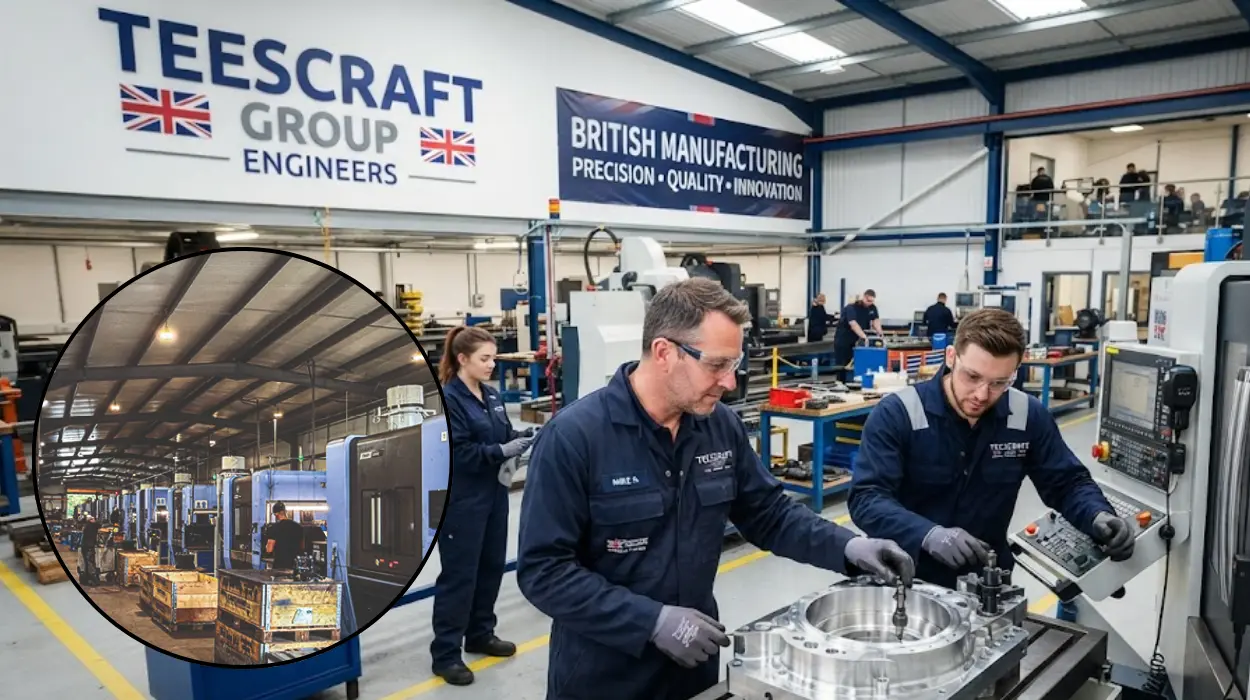
- The company combines iron and aluminium casting, multi-axis CNC machining, fabrication, finishing, assembly and logistics in a full end-to-end manufacturing model.
- A recent £3 million investment in a lights-out automated manufacturing cell is central to Teescraft’s long-term automation strategy.
- The automated cell was developed with a long-standing customer and is designed to deliver consistent, repeatable production around the clock.
- Teescraft says the project has created a blueprint for future automation across other product families and production lines.
- Rob Yorke says energy costs, grid infrastructure and industrial decarbonisation policy remain major issues for British manufacturers.
- Teescraft says future growth will focus on automation, digital manufacturing, people development, defence, energy and other high-value engineering sectors.
Bishop Auckland (Britain Today News) August 05, 2026 – The Teescraft Group has set out an ambitious vision for the future of British manufacturing as it marks its 45th anniversary in 2026, with Managing Director Rob Yorke saying the business is built on long-term customer relationships, investment in technology and, above all, its people.
- Key Points
- What is Teescraft’s 45th anniversary about?
- How did Rob Yorke rise through the business?
- Why does Teescraft stress people-first leadership?
- What does Teescraft actually manufacture?
- How important is Teescraft’s £3 million automation investment?
- What does lights-out manufacturing mean for future growth?
- Why are energy costs such a concern?
- How is Teescraft planning the next five years?
- What role do people play in Teescraft’s future?
- What does Teescraft’s story say about British manufacturing?
Founded in 1981 and now headquartered in Bishop Auckland, County Durham, Teescraft has grown into a leading Tier One precision manufacturing partner serving customers across the UK and international markets. The company works across automotive, defence, energy, oil and gas, offshore and general engineering, and says its strength lies in delivering complex components through an integrated manufacturing model that covers casting, machining, fabrication, finishing, assembly and logistics.
Yorke, who joined Teescraft in 1987 as a 16-year-old apprentice toolmaker when the business employed just five people, reflected on a career that has stretched across almost the entire life of the company.
“For me, this journey has been incredibly personal,”
He said. He later led a management buyout in 2002 and has remained closely connected to the firm’s evolution ever since.
The story of Teescraft, as Yorke tells it, is as much about continuity as it is about growth. It is also about a company that has tried to modernise without losing the values that helped it survive and expand across multiple manufacturing cycles, economic shifts and industrial changes over more than four decades.
What is Teescraft’s 45th anniversary about?
Teescraft’s 45th anniversary is not being presented simply as a milestone, but as a marker of resilience, adaptation and sustained industrial relevance. The company says 2026 is a moment to reflect on how it has changed from a small toolmaking operation into a broader manufacturing group with more than 200 employees.
Yorke said the business’s history is inseparable from the people who shaped it. He paid tribute to Edward “Ted” Page, who founded Teescraft in 1981, describing him as “an outstanding toolmaker” whose craftsmanship was exceptional. Yorke said,
“Watching him machine components was like watching a surgeon at work.”
He added that Page’s patience, attention to detail and willingness to teach were central to his own early development.
The anniversary also serves as a platform for Teescraft to describe the principles that underpin its current strategy. These include long-standing customer relationships, a committed workforce, continuous investment in capability and a willingness to adapt to changing markets. In the company’s view, those principles have helped it remain competitive in an environment where manufacturing businesses face pressure from costs, supply-chain complexity and fast-moving technological change.
How did Rob Yorke rise through the business?
Yorke’s progression through the company is one of the defining threads in Teescraft’s story. He joined as a teenage apprentice in 1987, at a time when the company was still operating on a very small scale. Over the decades, he moved through the business and eventually became part of the leadership team that completed a management buyout in 2002.
He also credited another influential figure, Cliff Laverick, who became his business mentor during the buyout period. Yorke said Laverick had helped establish Ebac in the 1970s and guided Teescraft through major steps including implementing ISO 9001 and purchasing its first CNC machine. The lesson Laverick left him with, Yorke said, was:
“turnover is vanity, profit is sanity, cash is king.”
That phrase, he added, remains part of how the company thinks about growth and financial discipline.
Teescraft’s account of Yorke’s career is notable because it reinforces the company’s emphasis on leadership continuity and in-house experience. Rather than presenting itself as a business transformed by outside intervention, Teescraft is framing its development as a long internal journey shaped by apprenticeships, mentoring and hands-on manufacturing knowledge.
Why does Teescraft stress people-first leadership?
Teescraft’s leadership says the company’s growth has depended on maintaining a culture that remains close to its workforce. Yorke said:
“Small and medium-sized businesses succeed because they remain close to their people. When you’re small, everyone knows each other, and culture develops naturally. As you grow, maintaining that culture becomes harder.”
That point appears central to the company’s current approach. Teescraft says technical competence matters, but so does hiring people who share the organisation’s values and ambition. For a manufacturing business that has moved from a modest workshop into a broader industrial group, the challenge is not only expanding capacity but preserving the workplace culture that helped build the business in the first place.
Yorke said building the right leadership team has been one of Teescraft’s biggest priorities. He argued that success has depended on balancing engineering skill with a shared understanding of how the business should operate. In his words, the company’s long-term success rests on “four factors”: strong customer relationships, a skilled and committed workforce, continuing technology investment and flexibility to evolve with the market.
Those themes are likely to resonate across the UK manufacturing sector, where firms often face a tension between scaling up and protecting the operational discipline and culture that made them viable in the first place.
What does Teescraft actually manufacture?
Teescraft presents itself as an end-to-end manufacturing partner with capabilities across multiple stages of production. Its work includes iron and aluminium casting, advanced 3-, 4- and 5-axis CNC machining, fabrication, finishing, assembly and logistics.
That breadth is important because it allows the company to control production from raw casting through to fully finished, ready-to-install assemblies. Teescraft says this model helps customers reduce lead times, simplify supply chains and achieve consistent quality. For sectors such as automotive, defence and energy, where precision and reliability are critical, end-to-end control can reduce the risks associated with fragmented supply chains.
The Group’s industrial position also reflects a wider shift in manufacturing, where companies are increasingly asked not just to make components but to act as integrated solution providers. Teescraft’s model suggests it sees competitive advantage in owning more of the process and reducing dependence on external handoffs.
How important is Teescraft’s £3 million automation investment?
Teescraft says continuous investment is central to its long-term growth strategy, and the most significant recent example is a £3 million investment in a state-of-the-art lights-out automated manufacturing cell. The company says the project marks a major step in its automation strategy and provides a template for future expansion.
Yorke described the investment as “a major milestone” and said the company worked collaboratively with one of its long-standing customers to develop a fully automated manufacturing cell capable of consistent, repeatable production around the clock. The project involved teams from production, engineering, quality, maintenance and management, with detailed work on fixturing, tooling, in-cycle inspection, Statistical Process Control and workflow design.
The significance of the project goes beyond a single production cell. Teescraft says the concept has now been proven and the next phase is scaling automation across suitable product families. That includes standardised fixturing and pallet systems, automated component loading, shared tooling strategies and enhanced digital quality monitoring.
In practical terms, the company sees the investment as both a productivity measure and a strategic demonstration. It says the automated cell shows how advanced manufacturing can be implemented without replacing skilled people entirely, instead allowing workers to focus on higher-value engineering tasks.
What does lights-out manufacturing mean for future growth?
Lights-out manufacturing refers to highly automated production that can continue with minimal human involvement, often outside normal working hours. For Teescraft, the approach is being used as a platform for lean, scalable production.
Yorke said:
“Now that the concept has been proven, the next phase is scaling automation across suitable product families.”
He added that the company will continue investing in automation, inspection technology and software integration to increase capacity, improve consistency and allow skilled staff to focus on more valuable work.
This matters because the company is not presenting automation as an abstract future trend. It is treating it as a practical response to real pressures on cost, capacity and competitiveness. By linking automation to quality monitoring, digital integration and production planning, Teescraft is positioning itself as a manufacturer that wants to compete on repeatability and reliability as much as on price.
The company’s strategy also suggests that automation is not being adopted in isolation. It is being embedded into wider operating systems, including machining, metrology and planning. That broader integration is likely to be a key factor in whether the business can expand automation successfully across additional lines.
Why are energy costs such a concern?
Yorke said one of the biggest challenges facing British manufacturers is energy costs. Teescraft said it is investing in efficiency improvements and renewable energy generation to reduce its reliance on volatile energy markets, but Yorke argued that broader policy and infrastructure are also essential.
“Energy costs remain one of the biggest challenges facing British manufacturers,”
He said.
“Like many businesses, we’re investing in measures that improve efficiency and reduce reliance on volatile energy markets, including renewable energy generation and factory-wide efficiency improvements.”
He added that national competitiveness depends on more than what individual companies can do alone. In his view, stronger support for industrial decarbonisation, investment in grid infrastructure and a more stable energy strategy would help manufacturers compete internationally while also supporting sustainability goals.
Yorke also said manufacturers have a role to play in sharing practical experience and showing that productivity and sustainability can work together. That message reflects a growing view in the sector that industrial competitiveness will depend not just on machine upgrades but on energy resilience and policy certainty.
How is Teescraft planning the next five years?
Teescraft says its ambition for the next five years is to become an even stronger and more capable UK manufacturing group. Yorke said the company wants to deepen its expertise in automation, digital manufacturing and programme management while expanding into defence, energy and other high-value engineering sectors alongside its existing automotive and industrial work.
The company also says it will continue investing in multi-axis machining capability, foundry operations, metrology and inspection processes, factory layout, production flow, energy efficiency and health and safety. These improvements are designed both to support existing customers and to open opportunities in new markets.
Yorke said the company’s priorities remain firmly tied to resilience and long-term relevance.
“Investment remains central to our growth strategy,”
He said, arguing that the business must continue improving operations while strengthening its position across UK manufacturing.
The strategy suggests Teescraft sees future success as a combination of technical depth, operational discipline and selective expansion into sectors where precision, reliability and repeatability are especially important.
Explore More about Business:
Segro Accepts £14bn Prologis Takeover Deal
TikTok Shop UK Sellers Surpass 300,000 Small Businesses
What role do people play in Teescraft’s future?
For all its focus on automation, Teescraft repeatedly returns to the importance of its workforce. Yorke said:
“Most importantly, we’ll continue investing in our people. Technology is essential, but it’s our workforce that defines the business.”
That statement is central to understanding how the company wants to position itself. Teescraft is not claiming that automation alone will secure its future. Instead, it is arguing that skilled people, when combined with advanced manufacturing capability, create a stronger and more competitive business than either element could on its own.
Yorke concluded by saying the company aims to ensure
“the next generation inherits a stronger, more resilient, and internationally competitive Teescraft Group.”
That reflects a long-term industrial identity rooted in succession, capability-building and continuity rather than short-term expansion.
As Teescraft approaches its fifth decade, its story is one of a business that has grown carefully, invested heavily and tried to keep its human culture intact. In a sector often shaped by change, that may be one of its most important assets.
What does Teescraft’s story say about British manufacturing?
Teescraft’s anniversary story is ultimately about more than one company. It reflects wider questions facing British manufacturing: how to automate without losing skills, how to grow without weakening culture and how to stay competitive while energy and infrastructure costs remain uncertain.
The company’s narrative suggests that future competitiveness will depend on a mixture of advanced machinery, disciplined management and investment in people. It also shows that long-term industrial success may still come from businesses that are willing to adapt slowly, commit capital and keep close to the customer.
For Teescraft, the future appears to be built on the same foundations that supported its past: engineering expertise, customer trust and a willingness to keep improving. In the company’s own view, that combination is what will allow it not only to survive the next chapter of British manufacturing, but also to help define it.