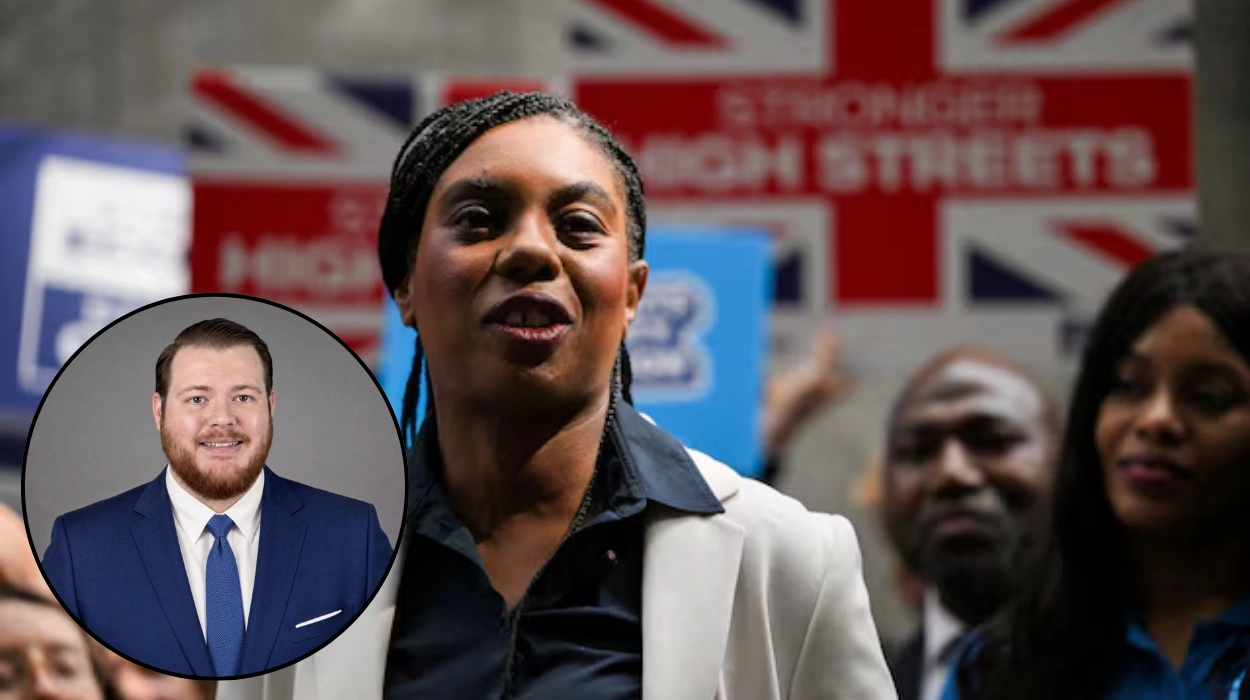
Key Points
- Kemi Badenoch defended the selection of Joshua Bonehill-Paine as a Conservative candidate for Somerset council.
- Bonehill-Paine was convicted in 2015 of racially aggravated harassment of Luciana Berger and imprisoned for stirring up hatred against the Jewish community.
- Badenoch said his past conduct was “appalling” but argued he had rejected his former views and was now rehabilitated.
- She said he would be standing for a local council role focused on everyday issues such as parking and refuse collection.
- Jewish organisations condemned the decision and urged the Conservatives to reverse it.
- The Board of Deputies of British Jews and the Jewish Leadership Council declined an invitation to meet him.
- Luciana Berger said there was a major distinction between education and public office.
- The controversy comes amid rising antisemitism in Britain and broader political pressure on parties to vet candidates more carefully.
- Badenoch also pointed to Labour’s record on antisemitism as part of her defence.
- The row adds to scrutiny of how political parties handle extremist histories in candidate selections.
London (Britain Today News) August 05, 2026 – The Conservative Party is facing intense criticism after leader Kemi Badenoch defended the selection of Joshua Bonehill-Paine, a former neo-Nazi and convicted hate criminal, as a local election candidate in Somerset, saying he had been rehabilitated and was now fit to serve on a council.
- Key Points
- Why has the Conservative Party defended the candidate?
- Who is Joshua Bonehill-Paine?
- What exactly did Badenoch say?
- Why are Jewish groups angered by the selection?
- What did Luciana Berger say?
- How serious is the antisemitism context?
- What does this mean for local elections?
- How are parties supposed to vet candidates?
- Why does the language matter so much here?
- What is the political damage for Badenoch?
- What happens next?
- Why is this story resonating beyond Somerset?
As reported in the political row surrounding the candidate’s selection, the decision has triggered condemnation from Jewish groups, revived debate over party vetting standards, and placed renewed focus on the wider challenge of antisemitism in British politics. Badenoch’s defence, delivered in an interview with the BBC, is now at the centre of a controversy that touches not only on one man’s past but also on the standards governing public life.
Why has the Conservative Party defended the candidate?
Badenoch argued that Bonehill-Paine should be judged on his present conduct rather than solely on his past. According to her remarks, his previous behaviour was unacceptable, but she said he had disavowed his former beliefs and was now in a position to serve in a local government role.
She presented the case as one of rehabilitation, suggesting that people who have renounced extremist views should not necessarily be permanently excluded from democratic participation. In her view, a local council position is not a national platform and is instead focused on practical responsibilities such as parking, refuse collection and other day-to-day local issues.
Her comments were intended to distinguish between a person’s previous ideology and the specific responsibilities of local office. The implication was that the council role would not grant him national influence, but would instead require him to deal with ordinary municipal matters.
Who is Joshua Bonehill-Paine?
Joshua Bonehill-Paine is a controversial figure whose past has made his candidacy especially explosive. In 2015, he was convicted of racially aggravated harassment of Luciana Berger, then a Labour MP, and he was also imprisoned for stirring up hatred against a Jewish community in north London.
His background places him among the most serious examples of a candidate with extremist and antisemitic associations to be backed by a major British political party in recent years. That history is why his selection has drawn such swift and widespread criticism.
Bonehill-Paine’s case is not being seen as a routine local candidate dispute. Instead, it has become a test of whether parties are prepared to apply strict standards when considering individuals with a history of racist or antisemitic conduct.
What exactly did Badenoch say?
Badenoch told the BBC that what Bonehill-Paine had done was “appalling”, while also saying he had moved away from those views and had shown genuine contrition. She said he was now fit to stand for local council because the role was limited in scope and was not equivalent to a national parliamentary candidacy.
She also pointed to his involvement with Prevent, the Government’s anti-radicalisation programme, as evidence that he had worked in a direction that suggested rehabilitation. In her argument, this was part of the reason she believed he should not be permanently written off.
Her remarks were framed as part of a broader fight against antisemitism in Britain. Badenoch said she wanted to build a movement against antisemitism, underlining that the issue remains politically and socially serious.
Why are Jewish groups angered by the selection?
The reaction from Jewish organisations was immediate and strong. The Board of Deputies of British Jews and the Jewish Leadership Council declined an invitation to meet Bonehill-Paine and urged the Conservatives to rescind his selection.
Their position reflected deep concern that allowing a figure with such a record to stand under the Conservative banner would send the wrong message about the seriousness with which the party treats antisemitism. For those groups, the issue was not only the individual’s past, but the symbolism of his endorsement.
As reported by observers of the row, many in the Jewish community see candidate selection as one of the clearest tests of political integrity. A person convicted of racially aggravated harassment of a Jewish MP and jailed for stirring up hatred against a Jewish community is, for them, not a borderline case but a line that should not be crossed.
What did Luciana Berger say?
Luciana Berger, now a member of the House of Lords, said there was a “massive distinction” between someone educating others about why their conduct was wrong and that same person standing for public office.
Her point was that contrition alone does not automatically make a person suitable for elected office, especially when the underlying conduct involved a sustained and targeted campaign. She stressed that Bonehill-Paine’s actions were not a one-off incident or careless remark, but a prolonged pattern directed not only at her but at others as well.
Berger’s intervention matters because she was one of the direct targets of Bonehill-Paine’s harassment. That gives her criticism particular moral force in the public debate about whether rehabilitation should ever extend to the point of political candidacy.
How serious is the antisemitism context?
This row comes at a time when antisemitism in Britain has remained a serious concern for years. Political parties of different stripes have repeatedly had to deal with accusations, suspensions, removals or expulsions linked to antisemitic behaviour or comments.
The wider climate gives the Bonehill-Paine selection added weight. It is not happening in isolation, but against a backdrop in which Jewish groups and campaigners have consistently pressed parties to show zero tolerance toward extremist or antisemitic conduct.
Badenoch has said she wants to help build a movement against antisemitism, but the controversy around this candidacy risks undermining that message. Critics will argue that a party cannot credibly talk about confronting antisemitism while defending the candidacy of a man with such a record.
Did Badenoch compare this to Labour?
Yes. Badenoch partly defended the selection by referring to Labour’s past handling of a candidate with a Nazi association at a local election in 2012. Her argument appeared intended to show that all parties have at times had difficult questions to answer over candidate vetting.
That comparison is politically significant, but it is also controversial. Critics are likely to say that one party’s past mistakes do not justify another party repeating a similar error, particularly where antisemitism is concerned.
Still, Badenoch’s point was clearly part of a broader attempt to frame the issue as one of consistency rather than exceptionalism. She sought to argue that political parties have all struggled with extremist histories among candidates and that the Conservative case should be judged in that context.
What does this mean for local elections?
The immediate issue is the Somerset council election, where Bonehill-Paine had been selected as a Conservative candidate. In local elections, parties often try to present candidates as community-focused and practical rather than ideological.
That makes the controversy especially damaging, because local candidates are meant to represent trust, competence and public service. A figure with a history of hate-related convictions raises obvious concerns about community confidence, local party discipline and the message being sent to voters.
Even if the candidate is standing for a limited local role, the political consequences are national. Opponents will use the case to question the Conservative Party’s judgment, while supporters of stricter rehabilitation policies may argue the party is being consistent with democratic principles.
How are parties supposed to vet candidates?
Political parties are expected to check backgrounds carefully before allowing someone to stand under their banner. That usually includes reviewing criminal records, public statements, past affiliations and any conduct that could embarrass or discredit the party.
In cases involving extremism or hate-related convictions, the reputational bar is especially high. Even if a person has legally served their sentence and says they have changed, parties must decide whether the symbolism and public trust risks are too great.
The Bonehill-Paine selection suggests that vetting is not only about legality but also about political judgment. A party can technically allow someone to stand and still face severe backlash if the choice appears morally indefensible to voters.
Is rehabilitation enough for public office?
This is the central moral question in the story. Badenoch’s defence rests on the idea that people can change and should not be barred forever from civic participation if they have genuinely abandoned extremist beliefs.
That view has some democratic appeal. Many would agree that society should leave room for redemption, especially when someone has demonstrably turned away from hate and taken steps to make amends.
However, public office is not the same as private employment. It carries symbolic authority, community trust and political legitimacy. For that reason, many will argue that even genuine rehabilitation may not be enough where a person’s past involved racially aggravated harassment and incitement against a targeted community.
Why does the language matter so much here?
The terms used in this debate are highly sensitive. Words such as “neo-Nazi”, “hate crimes”, “antisemitism” and “rehabilitated” do not just describe a record; they shape public perception of whether the individual is being treated as dangerous, reformed or politically acceptable.
That is why the way Badenoch framed the issue matters. By focusing on rehabilitation, she positioned the case as a question of principle. By contrast, her critics see the selection as a failure of moral judgment and a sign of insufficient seriousness about antisemitism.
The language also matters because the controversy is not abstract. It concerns a real community that has experienced targeted hatred, and a public figure who was directly affected by the candidate’s conduct.
What is the political damage for Badenoch?
The political damage is potentially significant. Badenoch has tried to present herself as firm on antisemitism and clear in her support for Jewish communities, but the defence of this candidate creates an obvious contradiction.
Even if she believes rehabilitation is possible, her critics may see the move as politically reckless and unnecessary. The decision opens her up to accusations that the Conservatives are willing to tolerate extremists when it suits local electoral strategy.
At a leadership level, the story could also raise questions about judgment. In politics, defending the indefensible can be as damaging as making the original decision, especially when the issue is tied to racism and antisemitism.
What happens next?
The most immediate question is whether the Conservative Party will stand by the selection or reverse it under pressure. Much will depend on internal party calculations, local election considerations and whether the backlash intensifies.
There is also the broader question of whether this episode will prompt tighter candidate screening across the party. If the controversy grows, it could force a more rigorous review of how candidates with extremist histories are assessed before selection.
For now, the row remains a test of the Conservatives’ judgment and Badenoch’s leadership. The party has chosen to defend a man with a deeply troubling past, but the political and moral consequences of that decision are still unfolding.
Explore More about Politics:
Burnham Rejects Epstein Inquiry as Pressure Mounts in 2026
Energy Minister Michael Shanks Accused Over Grid Safety Claims
Why is this story resonating beyond Somerset?
The reason this story has travelled far beyond a single local council contest is simple: it touches on one of the most sensitive issues in British public life. Antisemitism, political standards and extremist rehabilitation all collide here.
Voters may not follow every local candidate dispute, but they understand the symbolism of this case immediately. A party defending a former neo-Nazi candidate is likely to generate outrage regardless of the local context.
That broader resonance is why this will not remain merely a Somerset issue. It is now a story about standards, trust and the boundaries of rehabilitation in democratic politics.
Can the Conservatives recover from the backlash?
They can only do so if they respond decisively and consistently. That may mean withdrawing the candidacy, clarifying their selection criteria, or setting out a stronger public explanation that addresses the concerns of Jewish groups directly.
If they simply repeat that the candidate is “contrite” without confronting the seriousness of his record, the backlash is likely to continue. The public will expect more than procedural arguments; it will expect moral clarity.
As it stands, the Conservatives are trying to hold two ideas at once: that people can change, and that antisemitism must be challenged uncompromisingly. The problem is that this case has made those two positions look hard to reconcile.