Key Points
- Green Party leader Zack Polanski has called for fossil fuel producers to fund firefighting helicopters.
- He said the companies are “profiting from fuelling these infernos” during a period of severe UK wildfires.
- Polanski warned that Britain faces “the biggest threat to this country since the Second World War.”
- He urged Prime Minister Andy Burnham to stop new oil and gas drilling in the North Sea, naming Jackdaw and Rosebank.
- Chris Packham joined Polanski in central London and called for stronger wildfire warning systems.
- Packham also said policymakers should “criminalise irresponsible journalism” and act against misinformation.
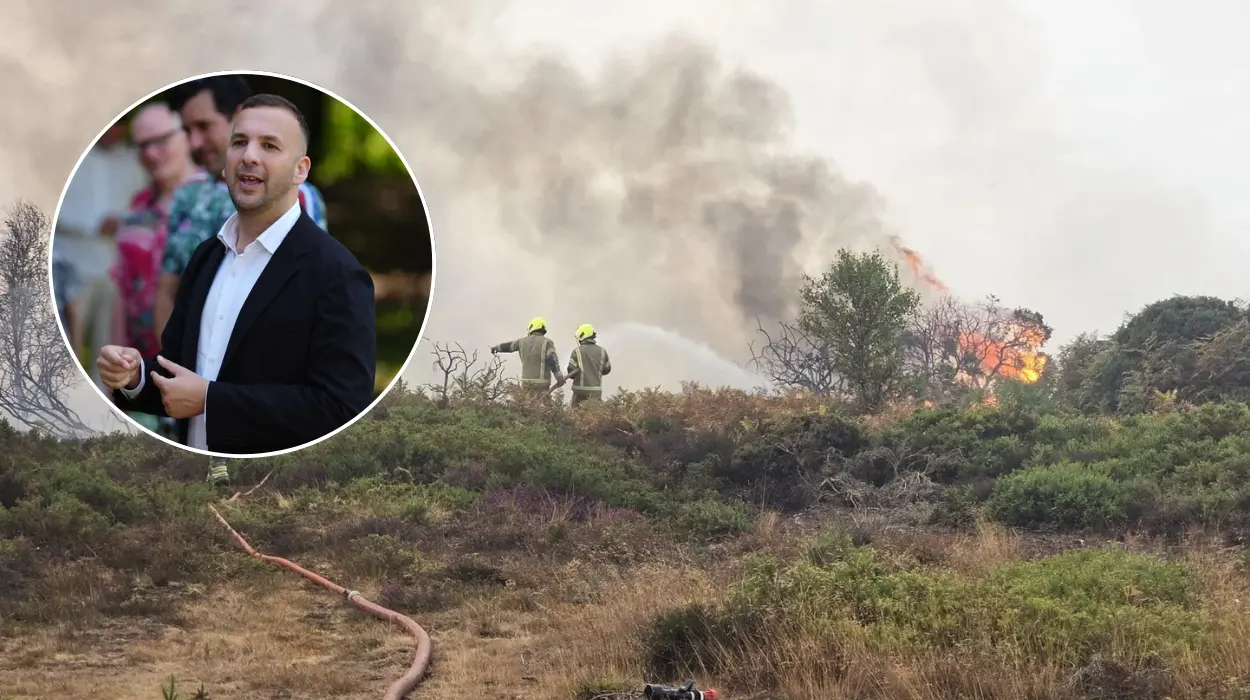
- The press conference came after major wildfire incidents in Suffolk, South Wales and the Cairngorms.
- Polanski said the Government has offered “no emergency briefings, no new plan and precious little detail.”
- He argued that wildfire response must include helicopters, stronger prevention and better-resourced fire services.
- He also repeated his call for water companies to be taken into public ownership.
London (Britain Today News) August 05, 2026 – Green Party leader Zack Polanski has used a press conference in central London to demand that fossil fuel giants help pay for firefighting helicopters, as Britain faces what he described as an escalating wildfire crisis.
- Key Points
- What exactly did Polanski say?
- What wildfires prompted the intervention?
- What did Chris Packham add?
- Why did Packham call for a warning system?
- What does this mean for wildfire policy?
- Why is North Sea drilling in the frame?
- How is water policy linked to this debate?
- What role does misinformation play?
- What happens next politically?
Speaking on Wednesday, Polanski said the country is confronting
“the biggest threat to this country since the Second World War,”
and argued that recent blazes across the UK show the scale of the danger now facing communities, emergency services and the wider environment.
His intervention came after a succession of wildfires that have caused alarm in different parts of the UK, including incidents in Suffolk, South Wales and the Cairngorms. Polanski said the latest fires should be treated as a warning of what may become a far more frequent pattern if ministers fail to act quickly.
The Green Party leader said the Government has not responded with the urgency the situation requires. He accused ministers of offering.
“no emergency briefings, no new plan and precious little detail about how this government will protect people from the crisis.”
What exactly did Polanski say?
Polanski delivered a series of direct warnings during the press conference, linking wildfire risk to climate breakdown, fossil fuel extraction and what he sees as weak political leadership.
He said:
“We are facing the biggest threat to this country since the Second World War.”
He also said:
“We need a robust wildfire prevention strategy, a fire service with the resources it needs to tackle blazes when they come.”
Polanski continued:
“And that must include firefighting helicopters when needed and not again ever seeing the shocking sight of requiring a charity to step in to contract a private firm to help fight fires.”
He added:
“And this should all be funded by taxing the fossil fuel giants who are profiting from fuelling these infernos.”
The Green Party leader also turned his attention to the wider energy debate, saying:
“I hope you will have the courage to be truthful, be brave and hold firm to your party’s commitment to no new oil and gas drilling in the North Sea, including both Rosebank and Jackdaw.”
He concluded that opposition to change is short-sighted, saying:
“Now, some will say we can’t afford to make these changes. These last few weeks are showing we can’t afford to – we are facing an existential threat.”
Why is he targeting fossil fuel companies?
Polanski’s central argument is that fossil fuel companies have played a major role in driving the climate conditions that make extreme wildfires more likely, more intense and more difficult to manage.
By calling for those companies to fund firefighting helicopters, he is making a policy link between the industries contributing to climate damage and the public cost of emergency response. In his view, the financial burden should not fall solely on taxpayers when corporate activity is worsening the conditions that fuel disaster.
His language was deliberately sharp. By saying fossil fuel giants are “profiting from fuelling these infernos,” he framed the issue not as a distant environmental debate but as a direct moral and economic question. That framing is central to the Green Party’s broader political approach, which seeks to connect climate policy to public safety, fairness and national resilience.
The proposal also fits a wider campaign message: that emergency planning should be upgraded for a hotter and more volatile climate, not just after disasters happen but before they spread.
What wildfires prompted the intervention?
The press conference followed a string of serious fires in different parts of the UK, each of which has helped sharpen public concern about wildfire preparedness.
Among the fires highlighted were incidents at Dunwich Heath in Suffolk, Llanwonno in the Rhondda Valleys in South Wales, and within the Cairngorms National Park in Scotland. These blazes have underscored the geographic spread of the problem and the fact that wildfire risk is no longer confined to traditionally vulnerable hot-weather areas.
The fact that the incidents were spread across England, Wales and Scotland gave Polanski’s message a national scope. He argued that the response should therefore be national too, with clearer planning, stronger coordination and improved public warnings.
His warning also reflected the growing awareness that wildfire season is no longer a narrowly defined period. With prolonged dry spells, rising temperatures and land management pressures all contributing, the UK is increasingly exposed to conditions that can turn a small ignition into a fast-moving emergency.
What did Chris Packham add?
Chris Packham, the BBC Springwatch presenter and naturalist, stood alongside Polanski in central London and made his own call for stronger public preparedness.
Packham asked:
“Is there a public wellbeing system in place which will tell people when there’s a risk of wildfire, so that they can be prepared to evacuate and have evacuation plans in place?”
He answered his own question by saying:
“Well, do you know what? There is.”
Packham said such a system already exists for the fire and rescue service, but is not available to the public because it is considered unreliable.
He then asked:
“Is it unreliable or is it just a bit too scary?”
Packham also criticised the absence of stronger restrictions on fire risks, saying:
“We couldn’t even instigate a ban on disposable barbecues.”
His contribution moved the discussion beyond firefighting aircraft and into wider public education, warning systems and behavioural change. He argued that people need timely, understandable information before emergencies escalate.
Why did Packham call for a warning system?
Packham argued that the public should not be left in the dark when there is a known risk of wildfire. In his view, warning systems are not merely technical tools for officials but essential public safety measures that help people prepare evacuation plans and avoid becoming trapped.
That idea is especially relevant in an age of more frequent climate-linked disasters, where rapid response and public alertness can save lives. Packham’s comments suggested frustration that the information already exists but is not being shared in a way that benefits the public.
By asking whether the system is “unreliable” or “a bit too scary,” he implied that institutions may be avoiding hard truths rather than confronting them. It was a pointed challenge to policymakers, emergency planners and media communicators alike.
His intervention also reflected his longstanding environmental campaigning. Packham has frequently used his platform to push for stronger climate action, biodiversity protection and a more urgent public conversation about ecological collapse.
What does this mean for wildfire policy?
Polanski’s comments are likely to intensify pressure for a more joined-up wildfire strategy in the UK. That would include prevention, emergency response, public education and long-term climate policy rather than treating each blaze as an isolated event.
A robust strategy, as Polanski described it, would require:
- Better-resourced fire services.
- More aerial firefighting capability, including helicopters.
- Clearer public warning systems.
- Restrictions on avoidable fire risks.
- A broader political commitment to reducing climate drivers.
He argues that emergency services should not have to improvise during major blazes, especially when the threat is becoming more predictable. He highlighted the “shocking sight” of charities having to step in to contract private firefighting support, suggesting this should never again be necessary.
If his campaign gains traction, the debate may move from response to responsibility: who should pay, who should prepare, and how much of the climate burden should be borne by industries linked to emissions.
Why is North Sea drilling in the frame?
A major part of Polanski’s message was his attack on new oil and gas drilling in the North Sea, particularly the Jackdaw and Rosebank fields.
He urged the Prime Minister to “be truthful, be brave” and stand by a commitment to halt new drilling. For Polanski, the issue is not only environmental but strategic: approving new fossil fuel projects while warning of climate danger appears, in his view, deeply inconsistent.
By naming Jackdaw and Rosebank, he made the call concrete rather than abstract. That approach matters in political campaigning because it ties a general climate position to specific decisions that can be tested publicly.
The Green leader’s language suggests he sees North Sea expansion as part of the same system that is pushing the UK into deeper climate risk. In that reading, more drilling today means more emissions tomorrow and more damage in the years ahead.
How is water policy linked to this debate?
Polanski also widened the discussion beyond wildfires and fossil fuels by calling for water companies to be taken “into public hands”.
He said money is “flowing out of our hands into the pockets of shareholders,” drawing a parallel with “water … flowing out of those companies’ leaky pipes” during a drought.
That comparison is designed to reinforce a broader political theme: essential infrastructure, whether water systems or emergency response, should not be managed primarily for private profit when public risk is rising.
The point matters because climate change affects not just temperature and fire but also drought, water stress and infrastructure resilience. Polanski’s remarks suggested that these challenges should be treated as interconnected rather than separate policy files.
His argument is essentially about ownership, accountability and long-term planning. In his view, public ownership would allow essential services to be run with resilience rather than shareholder returns at the centre.
What role does misinformation play?
Packham’s comments took the issue into the territory of media and public communication, where he argued that climate denial and false narratives can undermine effective action.
He said:
“We’ve got to address the mis- and disinformation and we’ve got to do that with positive information campaigns – we’ve got to have people’s minds on the front foot so they know what’s true before they hear the lies.”
He added:
“Then they will question the lies.”
Packham’s most controversial remark came when he said:
“I’ve been fantasising this year that we could perhaps criminalise climate denial – we should certainly criminalise irresponsible journalism.”
Those comments are likely to trigger debate about the limits of free speech, the responsibilities of the press and the challenge of communicating climate science in a hostile information environment. His broader point, however, was that public understanding matters because fear, denial and confusion can all delay action.
For Packham, the climate crisis is not only a scientific or policy issue but also a communication challenge. If people are misled about the scale of the danger, he suggested, they are less likely to support the measures needed to deal with it.
Explore More about Politics:
Conservatives Defend Former Neo-Nazi Candidate Amid Outrage
Burnham Rejects Epstein Inquiry as Pressure Mounts in 2026
What happens next politically?
The immediate political impact of the press conference will depend on whether Polanski’s demands gain traction with ministers, local authorities and the public. At minimum, the intervention has sharpened the debate over wildfire preparedness and the political response to climate-linked emergencies.
The Green leader has set out a clear line: fossil fuel companies should contribute to the cost of fighting the fires their industry helps worsen, and government should stop new fossil fuel expansion while strengthening prevention measures.
His remarks also place pressure on opponents to answer a difficult question: if the UK accepts that wildfire risk is rising, is the current system of response sufficient? If not, who should pay for the extra equipment, training and planning needed?
The issue is likely to remain live as climate impacts intensify and emergency services face greater strain. What Polanski and Packham have done is to push wildfire policy from the margins into the mainstream political argument.
Can the UK afford not to act?
That was the core of Polanski’s message. He argued that the country cannot keep treating climate-driven emergencies as exceptional events when they are becoming more common, more destructive and more expensive.
His statement that “we can’t afford to” act was designed to flip a familiar political argument on its head. Rather than asking whether stronger climate and emergency measures are too costly, he suggested the real question is whether failure to act will cost far more.
The press conference was not just about helicopters, drilling or water ownership. It was about the scale of the climate challenge and the political choices required to meet it.
For Polanski, the fires are a warning. For Packham, they are evidence that the public must be told the truth sooner and more clearly. Together, their remarks turned a series of local blazes into a national argument about responsibility, resilience and the cost of delay.