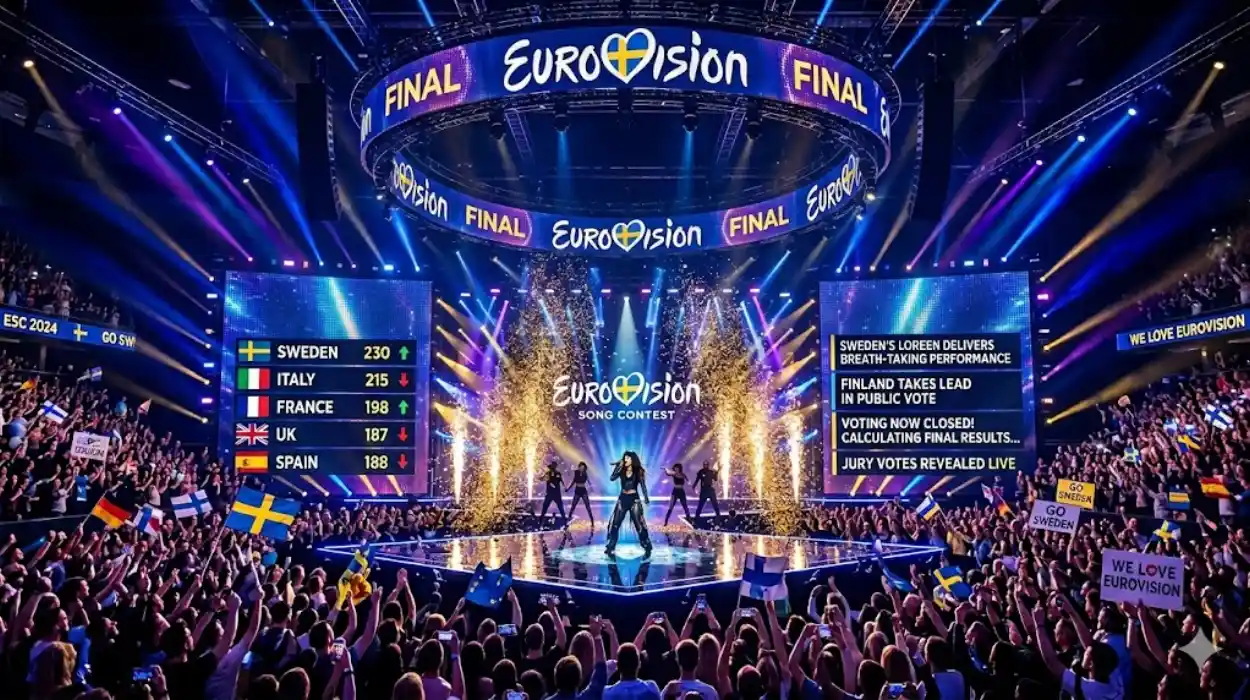
The Eurovision Song Contest final is the annual live television event where participating countries perform original songs, receive jury and public votes, and crown one grand winner. The 2025 contest was won by Austria’s JJ with the song “Wasted Love,” and the final remains one of Europe’s biggest entertainment broadcasts.
- What is the Eurovision final?
- How does the Eurovision final work?
- Who won Eurovision 2025?
- Why do live scores matter?
- What makes Eurovision so popular?
- How should readers follow Eurovision final updates?
- What happened in the 2025 final?
- Why does this article stay relevant?
- What should an SEO article include?
- How does the winner get decided?
- What is the lasting Eurovision result?
What is the Eurovision final?
The Eurovision final is the last live show of the Eurovision Song Contest, where qualifying countries perform again, votes are counted, and one entry wins the title of Eurovision champion. It combines national selection, live performance, and a two-part voting system from juries and viewers.
The Eurovision Song Contest is organised by the European Broadcasting Union, a cooperation of public-service broadcasters across Europe and beyond. It began in 1956 and has become a major annual music competition with national delegations, live staging, and a pan-European audience. The grand final is the most-watched part of the contest because it decides the winner.
Each finalist performs an original song within the contest rules. The songs are judged by professional juries and by the public televote, which creates a final ranking that often changes in the closing minutes of the broadcast. That live score reveal is the core reason Eurovision final coverage attracts large audiences worldwide.
How does the Eurovision final work?
The Eurovision final works through live performances, a combined jury and public vote, and a score reveal that determines the winner. Each country awards points, and the entry with the highest total wins the contest. The system is designed to balance expert opinion with viewer choice.
The final usually includes 26 songs, with entries coming from the host country, the “Big Five” broadcasters, and the countries that qualify from the semi-finals. The live show runs in a strict sequence, and every performance matters because jury impressions, staging, vocals, and audience reaction all influence the result.
The voting system uses two separate sets of points. National juries rank songs from musical and performance criteria, while the public vote reflects viewer support across participating countries. The suspense comes from the fact that the jury vote is announced first, followed by the public vote, which can transform the leaderboard in seconds.
The 2025 final showed that tension clearly. Austria’s JJ won after the final vote sequence, while the United Kingdom’s Remember Monday finished 19th with 53 points, including 88 jury points and zero public points. That split underlines how differently juries and viewers can respond to the same performance.
Who won Eurovision 2025?
Austria won Eurovision 2025 through JJ, who captured the grand final title after a close vote sequence in Basel. The winning entry was “Wasted Love,” and the result confirmed Austria as the year’s Eurovision champion after the final public vote was counted.
The 2025 contest was the 69th Eurovision Song Contest. JJ of Austria won the competition after beating 25 other countries in the grand final, while BBC live coverage confirmed the closing result and the late pressure from Israel’s Yuval Raphael.
Wales Online also reported that Austria’s JJ held off a late surge from Israel to secure the title. This is typical Eurovision final drama: a result that appears settled after the jury phase can change significantly once the public points arrive.
For audience searches, this is the key live-update pattern to remember. Eurovision final coverage usually centres on three moments: the performances, the jury leaderboard, and the televote reveal. The winner is the entry with the highest final score after both voting phases are combined.
Why do live scores matter?
Live scores matter because they create the central suspense of Eurovision final night and show how jury opinion and public support differ. The score reveal is the event’s defining mechanism, turning a music contest into a live ranking drama with an immediate winner.
The score board is more than entertainment. It is the contest’s main credibility tool because it makes the result transparent, time-bound, and verifiable in real time. Viewers can see how each country performs, how the voting shifts, and which songs build momentum during the show.
Eurovision live scores also shape public discussion after the final. Media outlets use the scoreboard to explain upsets, jury-favourite entries, and televote surges. That is why post-final coverage often focuses on “who won,” “who led after the juries,” and “who won the public vote” rather than only the song itself.
The 2025 result illustrates the point. Austria won, the UK underperformed in the public vote, and Israel remained in contention until late in the voting sequence. These kinds of shifts are exactly what make Eurovision final score reporting evergreen: the voting structure stays relevant every year even when the winner changes.
What makes Eurovision so popular?
Eurovision is popular because it combines live music, national identity, theatrical staging, and a high-stakes vote reveal. The final offers a clear winner, strong visual spectacle, and a format that works well for television, clips, and social media.
The contest draws attention because each country presents itself through performance, costume, staging, and language choices. This creates a mix of music competition and cultural showcase. The final is also easy to follow for casual viewers: every performance leads to a score, and every score builds toward one champion.
Eurovision also performs well as live-event content because it encourages real-time search behaviour. Viewers search for the latest scores, the running order, the finalists, and the winner while the show is still on air. That makes final-night articles highly discoverable when they explain the structure clearly and update the result quickly.
Each outlet focused on the same core search intent: the winner, the score outcome, and the key moments from the final vote. This confirms that the Eurovision final is a repeatable annual news topic with strong evergreen demand.
How should readers follow Eurovision final updates?
Readers should follow Eurovision final updates through reliable live coverage, official results, and published vote summaries. The best approach is to track the performance order, jury scores, televote totals, and the final winner announcement in one place.
A strong live update article begins with the winning country and artist, then explains how the final developed. It should identify the host city, the number of finalists, the voting structure, and the decisive score sequence. That format helps readers who arrive late and want the result immediately.
For search visibility, the article should use clear terms such as Eurovision final, live scores, grand final winner, televote, jury vote, and winning entry. Those phrases match the way audiences search during and after the broadcast, especially when they want fast answers on results and rankings.
The best evergreen coverage also explains the contest in neutral language. It defines the Eurovision final, describes the voting process, and then adds the year-specific winner. That structure supports both live breaking news and later reference traffic once the result becomes part of the contest’s historical record.
What happened in the 2025 final?
The 2025 Eurovision final ended with Austria’s JJ winning the contest in Basel, while the UK’s Remember Monday placed 19th. The final scoreboard showed a clear jury-versus-public contrast and confirmed Austria as the night’s overall winner.
BBC live coverage reported that Remember Monday received 53 points overall, with 88 jury points and zero points from the public. That result placed the UK 19th and highlighted one of the contest’s strongest talking points: a performance can score well with juries but still fail to attract televote support.
AP News reported the same winner, stating that JJ of Austria won the 69th Eurovision Song Contest after beating 25 countries in the final. Wales Online also reported that Austria held off a late surge from Israel’s Yuval Raphael, showing how competitive the closing vote remained until the end.
This is the essential takeaway for readers following Eurovision final live updates. The contest produces a definitive winner, but the path to that result depends on two separate voting systems and a live reveal that keeps the leaderboard uncertain until the final announcement.
Why does this article stay relevant?
This article stays relevant because the Eurovision final follows the same annual format, even though the winner changes every year. The contest’s core elements, including live performances, jury voting, public voting, and a grand winner announcement, remain consistent.
Evergreen search demand comes from the structure of the event rather than only one year’s result. People search for what the Eurovision final is, how voting works, who won, and how live scores are revealed. Those questions repeat each year, which makes the topic stable for SEO and AI search extraction.
The historical value also matters. Eurovision has run since 1956, so each new final adds another result to a long record of winners, scorelines, and national performances. Articles that explain the format and then anchor the latest winner in that history perform better than narrow breaking-news posts alone.
A well-structured Eurovision article should therefore combine definition, process, recent winner, and voting outcome. That balance serves readers who want immediate news and readers who want a lasting explanation of how the contest works.
What should an SEO article include?
An SEO article on Eurovision final live updates should include the winner, final score context, voting system, contest background, and clear definitions of key terms. It should answer the main user intent quickly and use concise headings that match common search questions.
The opening section should name the winner and the event year immediately. The next sections should explain how the final works, why the live score reveal matters, and how the result fits the contest’s broader history. That sequence matches how readers move from the headline to the explanation.
The article should also use consistent entity language. Mention Austria, JJ, Basel, the Eurovision Song Contest, jury vote, public vote, televote, and grand final in a natural way. Those entities help search engines connect the article to the event, the artist, and the result.
Finally, a strong evergreen Eurovision page should avoid unnecessary fluff. It should give the facts first, explain the mechanism clearly, and keep the writing direct. That approach supports both Google indexing and AI-generated answer systems that extract factual summaries from the page.
Explore More about Entertainment:
Alan Rothwell: Biography, Age, Career, Movies & Facts 2026
Television Licensing in the United Kingdom Made Simple
How does the winner get decided?
The winner gets decided by combining jury points and public televote points into one final score. The entry with the highest total after both phases wins the Eurovision final and becomes the year’s grand winner.
The final vote reveal is staged for maximum suspense. First, national juries deliver their results. Then the public vote is added country by country or in the event’s final aggregation format, depending on the show’s presentation. This two-step process creates the dramatic turnaround moments Eurovision is known for.
In 2025, Austria’s JJ emerged with the winning total after the last votes were counted. The UK’s 53-point total and zero public points show how a strong jury response does not guarantee a strong final placement. That split is one of the clearest examples of Eurovision’s mixed-vote structure in action.
This mechanism matters for long-term coverage because it explains every Eurovision final result. Regardless of which country wins in a given year, the same voting framework drives the outcome and shapes the live score narrative that audiences follow in real time.
What is the lasting Eurovision result?
The lasting Eurovision result is the official winning entry for that year, recorded alongside the final scores and rankings. For 2025, Austria’s JJ is the documented grand winner, and that result now sits in the contest’s official history.
The result matters beyond the live broadcast because it becomes part of Eurovision’s historical archive. Fans, journalists, and broadcasters return to the winner, the points breakdown, and the final ranking long after the show ends. That keeps Eurovision final articles useful well after publication.
In practical terms, the winning artist often receives increased international attention, streaming interest, and media coverage after the final. The Eurovision title works as a powerful career marker because it comes from a continent-wide broadcast with a large live audience and a documented points system.