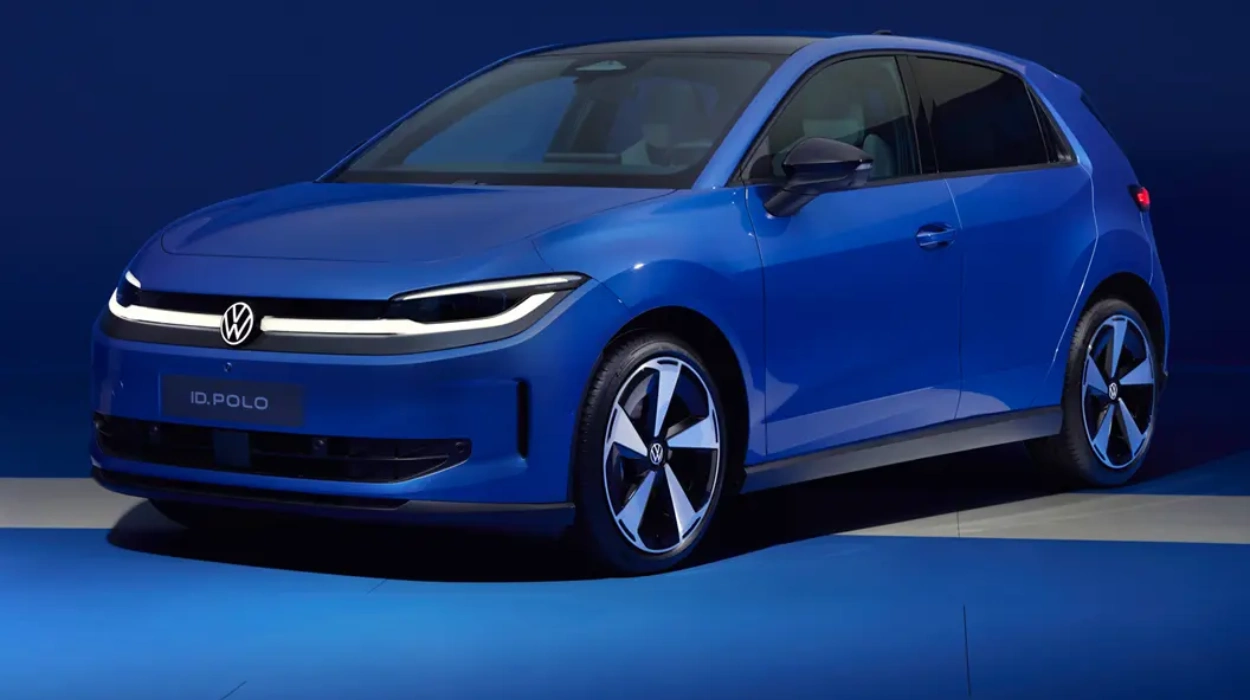
The Volkswagen ID. Polo is a new all-electric small car that combines compact dimensions, front-wheel drive, modern driver aids, and a launch target from 2026. Volkswagen says the range reaches up to 280 miles in the UK, with fast charging from 10% to 80% in 24 minutes.
- What is the ID. Polo?
- Why does the design matter?
- What are the main design versions?
- What are the prices?
- Where can buyers buy it?
- What range and charging does it offer?
- What space and practicality does it have?
- What technology is included?
- How did the ID. Polo develop?
- Which version fits which buyer?
- Why does it matter for the EV market?
- What should buyers watch before launch?
What is the ID. Polo?
The ID. Polo is Volkswagen’s all-electric compact hatchback built to replace the petrol-era small-car formula with an electric platform, efficient packaging, and a familiar Polo-sized body. Volkswagen positions it as an everyday car with five-seat practicality, a large boot, and modern tech.
The model sits in the small-car segment, which is one of the most important categories in Europe because buyers want low running costs, easy parking, and enough space for daily use. Volkswagen says the ID. Polo uses the MEB+ platform and front-wheel drive, which improves interior space and keeps the car simple to use.
Volkswagen also presents the ID. Polo as a direct continuation of the Polo name, but with electric power instead of combustion power. That matters for search intent because many buyers looking for “ID. Polo” want both the car’s identity and the practical details around ownership, specification, and purchase timing.
Why does the design matter?
The ID. Polo matters because Volkswagen has designed it to look familiar, stay compact outside, and feel more spacious inside than a traditional small hatchback. The design uses clear lines, real physical controls, large digital displays, and a cabin layout focused on ease of operation.
Volkswagen’s newsroom says the production model follows the Pure Positive design language developed by Andreas Mindt. The company states that more than 80 per cent of the concept vehicle’s design transferred to the production model, which shows strong continuity from concept to road car.
The exterior dimensions are also central to the design story. Volkswagen says the ID. Polo is 4,053 mm long, 1,816 mm wide, 1,530 mm high, and has a 2,600 mm wheelbase. Those figures place it close to the petrol Polo in size, while the electric packaging creates more usable cabin volume.
What are the main design versions?
The main design direction is a clean standard ID. Polo, plus a sportier ID. Polo GTI version announced for later release. Volkswagen also describes different power outputs and battery combinations, which create separate design-and-spec variants rather than separate body styles.
The standard model is built around calm, simple exterior styling and a practical five-door hatchback shape. Volkswagen says the car is intended to feel like a “friend from the very first encounter,” with warm-looking materials, clean buttons, and a coherent dashboard layout.
The GTI version shifts the design toward performance. Volkswagen says the ID. Polo GTI will be the most powerful production Polo ever, with 166 kW, or 226 PS, and an electronically controlled front-axle differential lock. That makes the GTI the headline sport design for buyers who want visual aggression and stronger road focus.
What are the prices?
Volkswagen has not released final UK pricing in the public model page, but it has said the entry-level ID. Polo will launch in many markets at under 25,000 euros. Secondary reporting in 2026 places UK estimates around £22,000 to £29,000, while a first-look report suggests a starting price near £21,000.
The most reliable public price statement comes from Volkswagen’s own newsroom, which gives a clear sub-25,000-euro entry target for many markets. That is an official price direction, not a final retail figure.
UK price estimates should be treated as provisional until Volkswagen publishes a full retail list. For evergreen coverage, the safest wording is that the ID. Polo is expected to be positioned as an affordable mainstream EV rather than a premium small car.
Where can buyers buy it?
The ID. Polo is available to view on Volkswagen’s official UK model page, and Volkswagen says the car is coming soon. The first purchase route will be through Volkswagen retailers and the brand’s official online sales channels once order books open.
Volkswagen’s UK page already exists for the model, which confirms official market support and future sales readiness. The page also includes the core claimed data on range, charging, boot space, and towing capacity.
In practical terms, buyers should expect three common channels. These are official Volkswagen dealers, official Volkswagen online reservations or configurators, and approved national retail networks once local launch timing begins. The official source remains the brand’s own sales infrastructure.
What range and charging does it offer?
Volkswagen says the ID. Polo can reach up to 280 miles of range in the UK and can charge from 10% to 80% in 24 minutes, with up to 105 kW DC on the UK page. The newsroom also states that some versions reach up to 450 km, depending on battery and output.
The battery strategy is split by version. Volkswagen says the lower-output cars use a 37 kWh net LFP battery, while higher-output versions use a 52 kWh net NMC battery. The larger battery supports the longer range claim and faster DC charging at up to 130 kW in the newsroom specification.
This matters because charging speed and range are the main purchase questions for EV buyers. A compact car with around 280 miles claimed range enters the usable daily-driving zone for commuting, school runs, shopping, and longer intercity trips.
What space and practicality does it have?
The ID. Polo is designed as a practical five-seat hatchback with up to 441 litres of boot space on the UK page and up to 435 litres in the newsroom specification. Volkswagen also says the car can tow up to 1,200 kg and offers more interior space than the petrol Polo.
The practical appeal is strong because the electric platform places the drive hardware efficiently in the front-wheel-drive layout. Volkswagen says passengers get 19 mm more interior space than in the classic Polo, and the luggage area grows from 351 litres to 435 litres in the newsroom comparison.
That boot space is important in the small-car market. A compact EV that carries family luggage, weekly groceries, and occasional travel gear has broader appeal than a city-only car. The ID. Polo is clearly aimed at that broader use case.
What technology is included?
Volkswagen equips the ID. Polo with assistive driving systems, large digital displays, steering wheel controls, and a simpler cabin layout that restores physical buttons for key functions. The car also adds Travel Assist features and parking support such as Park Assist Pro.
The technology approach is not just screen size. Volkswagen says the interior combines real buttons, digital displays on one visual axis, and an ID.Light interaction system that extends into the dashboard and front doors on some versions. That is designed to reduce driver distraction and improve usability.
The assistive systems also matter for safety and convenience. Volkswagen specifically names Connected Travel Assist, Park Assist Pro, and traffic light and stop sign recognition in Travel Assist for the ID. Polo. Those are the kind of features many modern buyers now expect in a new EV.
How did the ID. Polo develop?
The ID. Polo grew out of Volkswagen’s ID. 2all concept and became a production-ready small EV under the company’s new design and platform strategy. Volkswagen says the concept was shown in 2023 and that the production model reflects a high share of the original design.
This historical step matters because it explains why the car looks the way it does. The company says the design direction came from Andreas Mindt and his team, using the Pure Positive language to define the future look of compact Volkswagens.
The ID. Polo also marks a shift in Volkswagen’s EV naming strategy. The brand is attaching a familiar nameplate to an electric model, which gives the car stronger recognition than a purely numeric name. That is especially important in Europe, where the Polo name has decades of market familiarity.
Which version fits which buyer?
The 85 kW and 99 kW versions suit buyers who want lower-cost electric mobility, while the 155 kW and 166 kW versions suit drivers who want stronger performance and longer-range battery options. The GTI version targets buyers who want the most powerful and sport-focused ID. Polo.
Volkswagen says the 85 kW and 99 kW versions use the 37 kWh battery and the 155 kW and 166 kW versions use the 52 kWh battery. That makes the lineup easy to understand: lower output for affordability, higher output for range and performance.
The GTI version sits at the top of the range with 166 kW, or 226 PS. Volkswagen says it will be the first electric Volkswagen with an electronically controlled front-axle differential lock managed by Vehicle Dynamics Manager, which reinforces the performance positioning.
Why does it matter for the EV market?
The ID. Polo matters because it brings a mainstream brand, a familiar small-car size, and a lower entry price target into the electric market. It also shows how Volkswagen plans to compete in the affordable EV segment with practical range, fast charging, and wider market reach.
The small electric car segment is important because buyers want a balance of price, range, and everyday practicality. Volkswagen’s target of under 25,000 euros in many markets signals an effort to make EV ownership more accessible.
The car’s timing also matters. Volkswagen says the model is part of a broader wave of new small and compact electric launches from 2026. That places the ID. Polo in a crowded but fast-growing space where value, efficiency, and brand trust decide purchase intent.
What should buyers watch before launch?
Buyers should watch final trim names, official market pricing, battery-specific range figures, charging details by version, and local delivery timing. Volkswagen’s official materials confirm the platform and core specifications, but full retail configuration remains the next critical release.
The final specification sheet will determine the real purchase decision. Equipment levels often change boot space, wheel size, charging speed, and driver-assistance bundles, which directly affect price and usability.
For anyone building evergreen content around the model, the best editorial angle is to separate confirmed facts from launch-stage estimates. Confirmed facts include the platform, size, range claims, boot space, and GTI power output. Estimates include some market prices and exact sale timing.
The ID. Polo is therefore a major new entry in the electric small-car category, not just another model refresh. It combines a compact footprint, a practical cabin, official fast-charging claims, and a launch strategy built around affordability and familiar branding.