Key Points
- The British Medical Association (BMA) is under fire for offering its staff a below-inflation 2.75% pay rise while demanding a 26% increase for resident doctors.
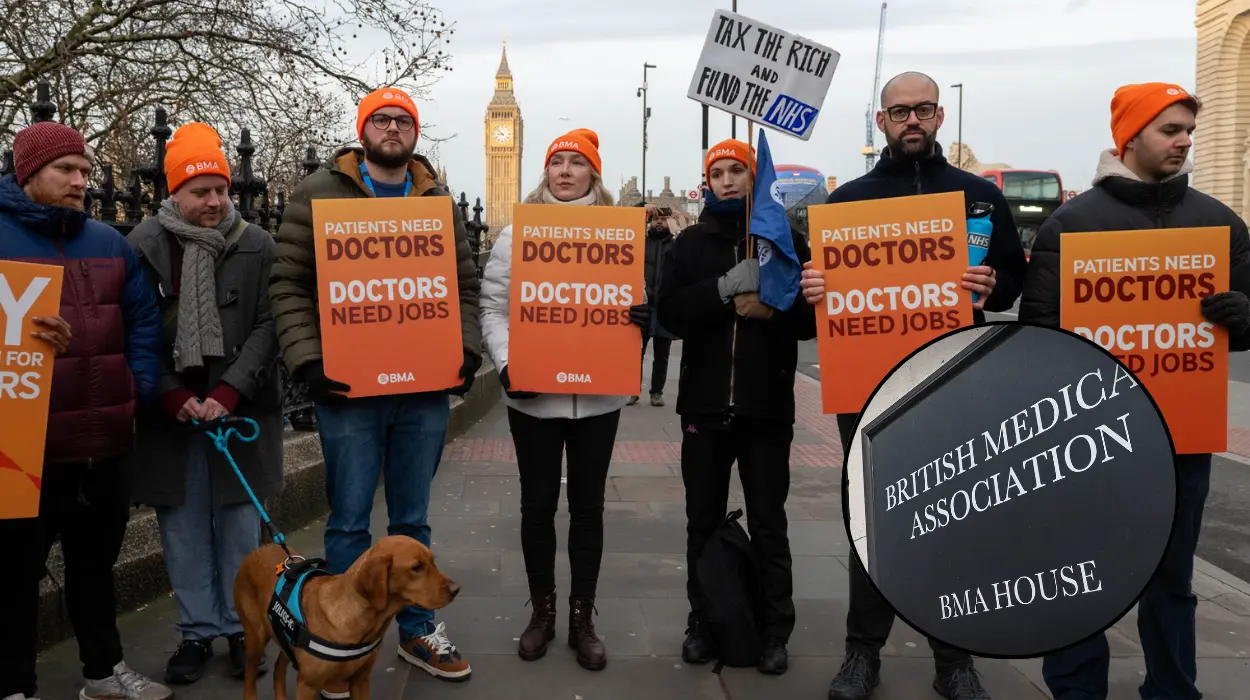
- BMA staff began a 48-hour strike after rejecting the union’s pay offer; the walkout coincides with a six-day strike by resident doctors.
- Health Secretary Wes Streeting criticised the BMA for “hypocrisy”, noting resident doctors had already received a 35.2% pay rise on average since 2020.
- Donna Thomas from the GMB union accused the BMA of failing to “restore” its own staff’s pay while campaigning for doctors’ “full pay restoration.”
- The BMA cited budget pressures for its limited staff offer, while continuing its demand for a 26% government-funded rise for doctors.
- The strikes affected NHS services across England, leading to cancellations and delayed treatments.
- A YouGov poll showed that 55% of the British public oppose the ongoing resident doctor strikes.
- BMA resident doctors’ chair Dr Jack Fletcher said medics “had no choice” but to strike amid “epidemic levels of corridor care” and high waiting lists.
England (Britain Today News) April 7, 2026 — The British Medical Association (BMA), representing tens of thousands of doctors across the UK, has come under intense scrutiny and criticism after its own employees went on strike over a below-inflation pay offer. The apparent contradiction has led political leaders and union representatives to accuse the BMA of “hypocrisy,” as the organisation campaigns for far higher pay rises for NHS doctors than it offers to its own workers.
- Key Points
- Why are BMA staff striking while the union demands higher pay for doctors?
- What has the government said about the BMA’s demands?
- How is the BMA justifying its approach to staff pay?
- What impact are the strikes having on NHS services?
- What has been the reaction from doctors’ representatives?
- How has the public responded to the doctors’ strikes?
- What are the next steps in the pay dispute?
Why are BMA staff striking while the union demands higher pay for doctors?
The controversy erupted when hundreds of BMA staff launched a two-day strike beginning Monday, following the association’s proposal of a 2.75% wage increase. According to reports, this offer is significantly below the rate of inflation and well beneath the 26% rise the BMA has demanded for resident doctors from the government.
The BMA staff on strike include a range of professionals — from policy advisers and communications officers to IT specialists and negotiators — many of whom played vital roles in supporting the Doctors’ Committee during their long-running pay dispute with ministers.
Speaking on behalf of the GMB, which represents BMA employees, regional organiser Donna Thomas accused the union of double standards. Thomas stated that
“the BMA is asking the government for pay restoration for their doctor members but have failed to restore the pay of their own staff, who have seen their wages eroded nearly 17%.”
She further questioned why the BMA, which vocally champions fairness in pay across the NHS, could not apply the same principle to its internal staff.
What has the government said about the BMA’s demands?
In response to the ongoing dispute, Health Secretary Wes Streeting sharply criticised the BMA’s position, describing it as “the height of hypocrisy”.
Streeting pointed out that the BMA had rejected a government offer that would have delivered resident doctors an average pay rise of 4.9% this year — almost twice the 2.75% it is extending to its own staff. According to Streeting, that government offer would also have given the lowest-paid doctors a 6.2% increase and represented an average total rise of over 35% compared to four years ago.
“Resident doctors are, by a country mile, the standout winners of the entire public sector workforce when it comes to the pay rises they have received from this government,”
Streeting said in his statement.
“The day they rejected our deal, they called six more days of strikes, costing the NHS £300 million.”
Streeting continued,
“Why does the BMA think they can tell their own staff they only get 2.75% because that’s all they can afford, whilst rejecting a 4.9% offer because that’s all the government can afford? That, to me, is blatant hypocrisy.”
How is the BMA justifying its approach to staff pay?
The BMA has defended its position, insisting that its hands are tied by internal budget constraints. According to statements attributed to the organisation,
“the union’s limited budget makes it impossible to offer higher increases without fundamentally hurting financial sustainability.”
This rationale has done little to appease critics. For many observers, the BMA’s financial explanation contrasts uncomfortably with its public stance that the government must find money to fund doctors’ significant pay restoration.
Many commentators have observed that the BMA’s own financial health appears to undermine its broader negotiation arguments. If the doctors’ union cannot afford inflation-matching increases for its internal team, the government is likely to question whether it can—or should—be compelled to allocate taxpayer resources to fund a 26% uplift across resident doctors.
What impact are the strikes having on NHS services?
The resident doctors’ strike marks the fifteenth bout of industrial action since March 2023. NHS England confirmed that some appointments and procedures had to be cancelled or rescheduled due to the walkout.
To mitigate disruption, hospital consultants and specialist doctors were redeployed to cover essential services. However, healthcare leaders warned that prolonged disruption could further damage patient confidence in the NHS. Health officials reiterated their call for patients to seek medical care when necessary, urging them not to delay consultations due to strike activity.
At Bristol Royal Infirmary, one striking medic, Dr Sam Taylor-Smith, said he recognised the public’s frustration but argued that the dispute was about
“protecting the future of safe and fair employment in the NHS.”
He added,
“I apologise to patients whose appointments were cancelled, but I do that 365 days a year because of understaffing and waiting lists.”
What has been the reaction from doctors’ representatives?
Resident doctors’ committee chair Dr Jack Fletcher expressed regret over the continued industrial action but said medics “had no choice.” In remarks on Tuesday, Fletcher said,
“We gave the government several opportunities to avoid this. They chose not to. We are now forced into a position where speaking up for fair pay and sustainable working conditions is the only course left open to us.”
Fletcher also said that the government’s approach to negotiations was “political posturing” and not reflective of the reality on the ground in hospitals.
“This is not a partisan campaign. This is about keeping staff motivated and patient care safe,”
he added.
How has the public responded to the doctors’ strikes?
Polling data released by YouGov this week revealed that public sentiment is beginning to shift against the strikes. According to the survey of 4,385 adults, 55% of respondents said they oppose the resident doctor walkouts, while 37% continue to support them.
Some medics acknowledge that public patience is wearing thin. Others argue that the government has allowed the situation to drag on for too long and that short-term disruption is necessary to prevent longer-term workforce collapse in the NHS.
What are the next steps in the pay dispute?
As the six-day strike continues, both sides remain entrenched. The BMA insists that only a substantial pay restoration package spread over multiple years will resolve the dispute, while the Department of Health says further concessions are unrealistic without wider structural reforms within the NHS.
Health Secretary Streeting maintains that the government “bent over backwards” to meet doctors halfway. He added that industrial action now risks eroding public goodwill and slowing progress on NHS recovery targets.
For the BMA, the parallel strikes — both internal and external — have become a public relations challenge as much as a policy one. The union, known for its advocacy on behalf of doctors, is now under scrutiny for how it treats its own workforce, drawing uncomfortable attention to internal practices amid its campaign for pay fairness.
With no sign of an immediate breakthrough, analysts predict that the deadlock could extend into summer, further pressuring hospital operations and patient waiting times.