Key Points
- At least five survivors of sexual abuse by Mohamed Al Fayed have received conclusive grounds decisions from the Home Office confirming they are victims of modern slavery and human trafficking.
- The cases involve both international and domestic trafficking, including one instance of trafficking that occurred entirely within the Harrods building.
- Recruitment methods varied: one victim was hired into a fake role, two were recruited for genuine jobs before being selected for abuse away from the shop floor, and another was employed as a domestic worker via a letting agency called Hyde Park Residence.
- The abuse cases span from the 1990s to after Harrods was sold in 2010.
- All five survivors were referred to the National Referral Mechanism (NRM) by the charity Unseen UK.
- Four survivors — using the pseudonyms Justine, Elizabeth, Margo and Isabella — belong to an advocacy group called No One Above and have spoken about their decisions.
- More than 400 allegations of sexual misconduct against Mohamed Al Fayed have been recorded, spanning 1977 to 2014.
- The Metropolitan Police is investigating at least 156 victims as part of Operation Cornpoppy, which is examining people who may have enabled Al Fayed’s abuse.
- Four people have been questioned so far in the investigation, which has been running for 19 months.
- The Home Office has said it is “fully committed” to supporting survivors and has pointed to its violence against women and girls strategy.
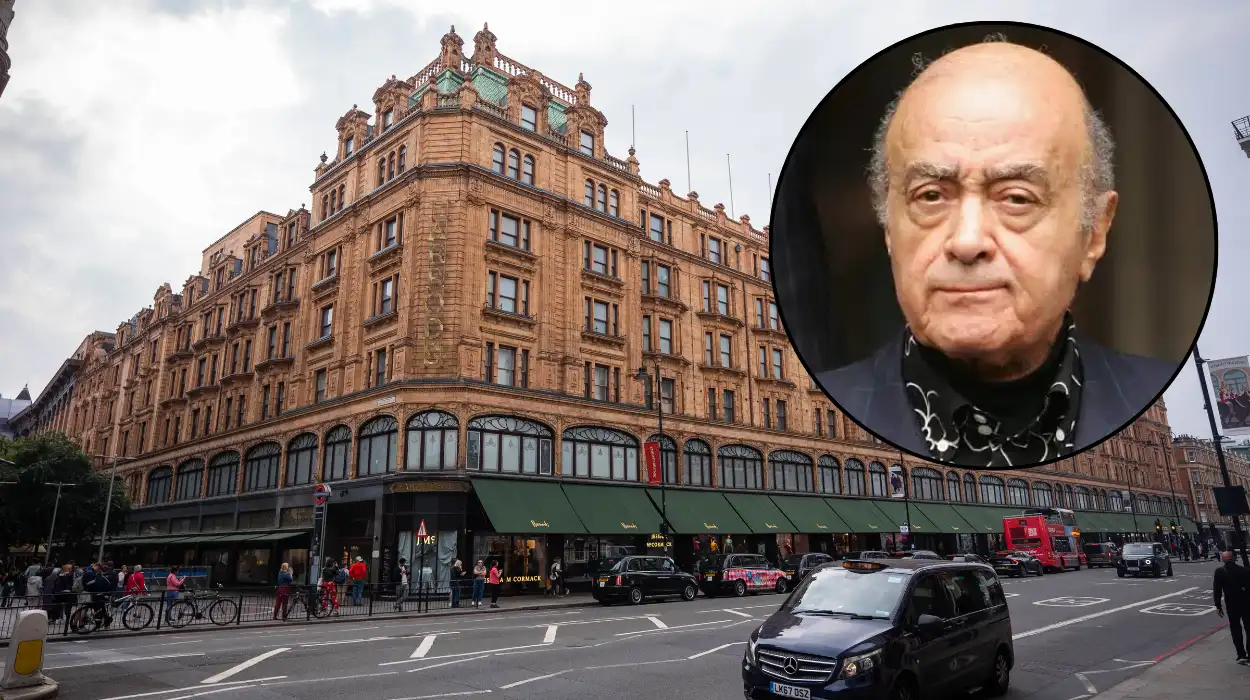
London (Britain Today News) August 03, 2026 – At least five survivors of sexual abuse by Mohamed Al Fayed have been confirmed by the Home Office as victims of human trafficking, in what campaigners describe as concrete proof that the abuse at Harrods was part of an organised system rather than the actions of one individual. The decisions cover both international and domestic trafficking, including a case in which the trafficking took place entirely within the walls of the Knightsbridge department store once owned by the late billionaire.
- Key Points
- What has the Home Office confirmed about Al Fayed’s victims?
- What is the National Referral Mechanism and how does it work?
- Who can refer potential victims to the NRM?
- How are conclusive grounds decisions reached?
- When did the first survivor receive a positive decision?
- Who are the members of the No One Above advocacy group?
- What did Justine say about receiving her decision?
- What did Elizabeth say about the trafficking system at Harrods?
- What did Margo reveal about the wider trafficking network?
- What did Isabella say about Harrods’ role in the abuse?
- How many allegations have been made against Mohamed Al Fayed?
- What is Operation Cornpoppy and what has it found so far?
- What has the Home Office said in response to the decisions?
- What happens next for survivors and investigators?
What has the Home Office confirmed about Al Fayed’s victims?
The Home Office has confirmed that five survivors of abuse by Mohamed Al Fayed have received conclusive grounds decisions from the National Referral Mechanism, formally recognising them as victims of modern slavery. This includes cases of both international and domestic trafficking, as well as one case of trafficking that occurred inside the Harrods building itself.
The circumstances of recruitment differed between victims. One survivor was recruited into a role at Harrods that did not genuinely exist, while two others were hired for legitimate positions on the shop floor before being selected for abuse. A further survivor was employed as a domestic worker for a member of the Fayed family, having been recruited through a letting agency named Hyde Park Residence. The cases span a broad period, with the earliest dating back to the 1990s and the most recent occurring after Harrods was sold in 2010.
What is the National Referral Mechanism and how does it work?
The National Referral Mechanism is the United Kingdom’s official framework for identifying victims of modern slavery, which includes human trafficking, forced labour and servitude. The framework is designed to ensure that victims receive appropriate support while also supplying the Government with data on the scale of modern slavery across the country.
Statutory first responders — including police forces, Border Force, the National Crime Agency and local authorities — are required to offer an NRM referral to any adult they have reasonable grounds to believe may be a victim of modern slavery. In addition, certain non-governmental organisations are permitted to act as non-statutory first responders, allowing them to make referrals directly. These organisations include Unseen, the Salvation Army, Barnardo’s and the Refugee Council.
Who can refer potential victims to the NRM?
Once an individual is referred into the system, the Single Competent Authority, which sits within the Home Office, is responsible for assessing the referral. The Single Competent Authority first decides whether there are reasonable grounds to believe the person is a victim of modern slavery. Following further investigation, it then issues a conclusive grounds decision confirming or rejecting that status.
In the case of the Al Fayed survivors, all five referrals were made by the charity Unseen UK, which specialises in supporting victims of modern slavery and trafficking across the UK.
How are conclusive grounds decisions reached?
A conclusive grounds decision represents the final stage of the Home Office’s assessment process, arrived at only after officials have examined the evidence supporting a survivor’s account. For the Al Fayed case, this two-stage process — moving from reasonable grounds to conclusive grounds — has now been completed for at least five individuals, each of whom has been formally recognised as a trafficking victim.
Isabella, one of the survivors who has received a decision, said:
“We are not aware of any negative decisions in this case, and there have now been many self-initiated referrals through Unseen.”
When did the first survivor receive a positive decision?
The first survivor known to have received a positive conclusive grounds decision was Rachel Louw, whose case was reported on 29 April 2026 after she disclosed abuse suffered at the hands of Mohamed Al Fayed and his brother, Salah. Since that report, four further individuals connected to an advocacy group called No One Above have also received conclusive grounds decisions confirming they are victims of modern slavery. These four survivors use the pseudonyms Justine, Elizabeth, Margo and Isabella. It is understood that additional survivors beyond these five have also received positive decisions, though their identities have not been made public.
Who are the members of the No One Above advocacy group?
No One Above is an advocacy group formed by survivors of abuse connected to Mohamed Al Fayed. Justine worked at Harrods for more than three years during the 1990s, during which time she was trafficked and abused. Elizabeth was also employed at Harrods and received her conclusive grounds decision in May. Margo worked as a domestic employee for the Fayed family after the sale of Harrods, having been recruited through Hyde Park Residence, and received her decision in July. Isabella worked within the chairman’s office at Harrods in 2001 and received her decision in May.
What did Justine say about receiving her decision?
Justine received her conclusive grounds decision in June, confirming that she had been a victim of modern slavery. Describing the moment she received the news, she said:
“It’s not something I realised was happening to me at the time, so it’s all part of this journey that we’re on now in reliving this experience, and actually really understanding what happened to us, which is very difficult.”
She continued:
“But it’s a really significant thing, getting that decision, seeing it in writing that you were a victim of modern slavery and trafficking is very… It’s really shocking to read.”
Justine said the decision amounted to “concrete confirmation” from the Home Office that survivors connected to Al Fayed were victims of human trafficking, and stressed that the range of experiences was wide, spanning domestic and international trafficking, and both those who worked at Harrods and those who had no connection to the store at all. She said this was significant because Harrods’ position had been that the abuse was the work of “one bad man” and that nothing further could be done given his death. Justine added:
“These decisions illustrate that that is not the case at all.”
What did Elizabeth say about the trafficking system at Harrods?
Elizabeth, who also worked at Harrods, said she believed all of the survivors connected to the Al Fayed case were victims of human trafficking because a single system had been used to recruit, exploit and silence them. She said:
“Everybody connected with this case is a trafficking victim, because it was all one system. You can’t say that victim A wasn’t trafficked and victim B was.”
Elizabeth also raised concerns about how trafficking is understood by investigating authorities, stating:
“I think there’s this persistent misunderstanding, possibly within the Metropolitan Police themselves, which is scary, that trafficking only involves being moved across international borders. There have been positive conclusive grounds trafficking decisions in cases where the trafficking occurred within the Harrods building.”
What did Margo reveal about the wider trafficking network?
Margo, who was employed as a domestic worker for the Fayed family following the sale of Harrods, said she had not originally identified as a victim of trafficking because she had not understood what domestic trafficking involved. She said Al Fayed’s network of abuse extended “so beyond Harrods”, listing multiple locations and businesses connected to him:
“This was Balnagown, it was Saint-Tropez, it was Fayair, it was Fulham Football Club, it was Hyde Park Residence. Everywhere he went he had enablers, and everywhere he went he had the capacity to abuse. All of his residences, all of his businesses.”
Margo explained that she had been reluctant to come forward earlier because she had not worked at Harrods, adding:
“There has just been so much emphasis put on Harrods to the point where I believe that there are so many more victims that haven’t come forward because they believe that it’s solely a Harrods issue. I know of one other Hyde Park Residence victim, but there has to be hundreds more somewhere.”
What did Isabella say about Harrods’ role in the abuse?
Isabella, who worked in the chairman’s office at Harrods in 2001, said the public often misunderstood the scale of the abuse. She said:
“I think one thing that the public doesn’t understand is they think this was one bad man, but he couldn’t have done what he did without Harrods processing women to him and silencing them afterwards. And it wasn’t just Harrods, obviously. It was any entity that Al Fayed owned or had control of.”
She added that the network extended well beyond the department store:
“It was his yachts, his aviation business, the Ritz Paris, his properties all over France and Monaco, it went as far as the States and the UAE – anywhere that man touched.”
Isabella said the abuse involved “a wider network of perpetrators” beyond Mohamed Al Fayed himself.
How many allegations have been made against Mohamed Al Fayed?
More than 400 allegations of sexual misconduct have been made against Mohamed Al Fayed, covering a period between 1977 and 2014. These allegations include sexual assault, rape, sexual exploitation and human trafficking, making it one of the largest cases of alleged historical sexual abuse to be investigated in the UK.
Explore More about Crime:
British Woman Found Dead in Suitcase: Suspect Arrested in Greece
Norwegian Teen Convicted in London for Plotting Contract Killing on Behalf of Iran-Linked Network
What is Operation Cornpoppy and what has it found so far?
The Metropolitan Police is investigating the allegations under an operation known as Operation Cornpoppy. Officers are examining claims from at least 156 victims who have contacted them directly, including 21 individuals who came forward before Mohamed Al Fayed died in 2023 at the age of 94. The investigation is focused not only on Al Fayed’s own conduct but on identifying people who may have facilitated or enabled his crimes.
Four people have been questioned as part of the investigation to date, 19 months after Operation Cornpoppy was formally opened.
What has the Home Office said in response to the decisions?
A Home Office spokesperson responded to the confirmation of the survivors’ status, saying:
“Our heartfelt condolences go out to all those affected by this distressing case. We are fully committed to supporting victims and giving survivors the support and certainty they need to recover.”
The spokesperson added:
“Our violence against women and girls strategy sets out how the full power of the state will be deployed to deliver the largest ever crackdown on violence against women and girls in British history.”
What happens next for survivors and investigators?
With additional survivors understood to have received positive conclusive grounds decisions beyond the five confirmed cases, campaigners say the number of recognised victims is likely to grow. Advocacy group members have called for wider recognition that the abuse extended across all of Mohamed Al Fayed’s business interests, not solely Harrods, and have urged others who may not have worked at the store to come forward. Operation Cornpoppy remains ongoing, with the Metropolitan Police continuing to investigate individuals who may have enabled the abuse over several decades.